OA Week 2025: Colby Authors in 2025

OA Week is an annual awareness-raising campaign for individuals and organizations across the globe to encourage and reflect upon efforts to increase open access to information – free, immediate, online access to research and the right to use information as needed. This year’s theme of Who Owns Our Knowledge “asks a pointed question about the present moment and how, in a time of disruption, communities can reassert control over the knowledge they produce.”
Today, we turn to how Colby faculty and staff disseminate the findings of our own research, specifically in the case of scholarly articles. In other words, we’re interested to see who owns Colby’s knowledge. Using publication data pulled from Scopus for works published in 2025 by Colby affiliates, we are able to focus on 111 scholarly journal articles published by Colby faculty and staff researchers over the past 10 months.
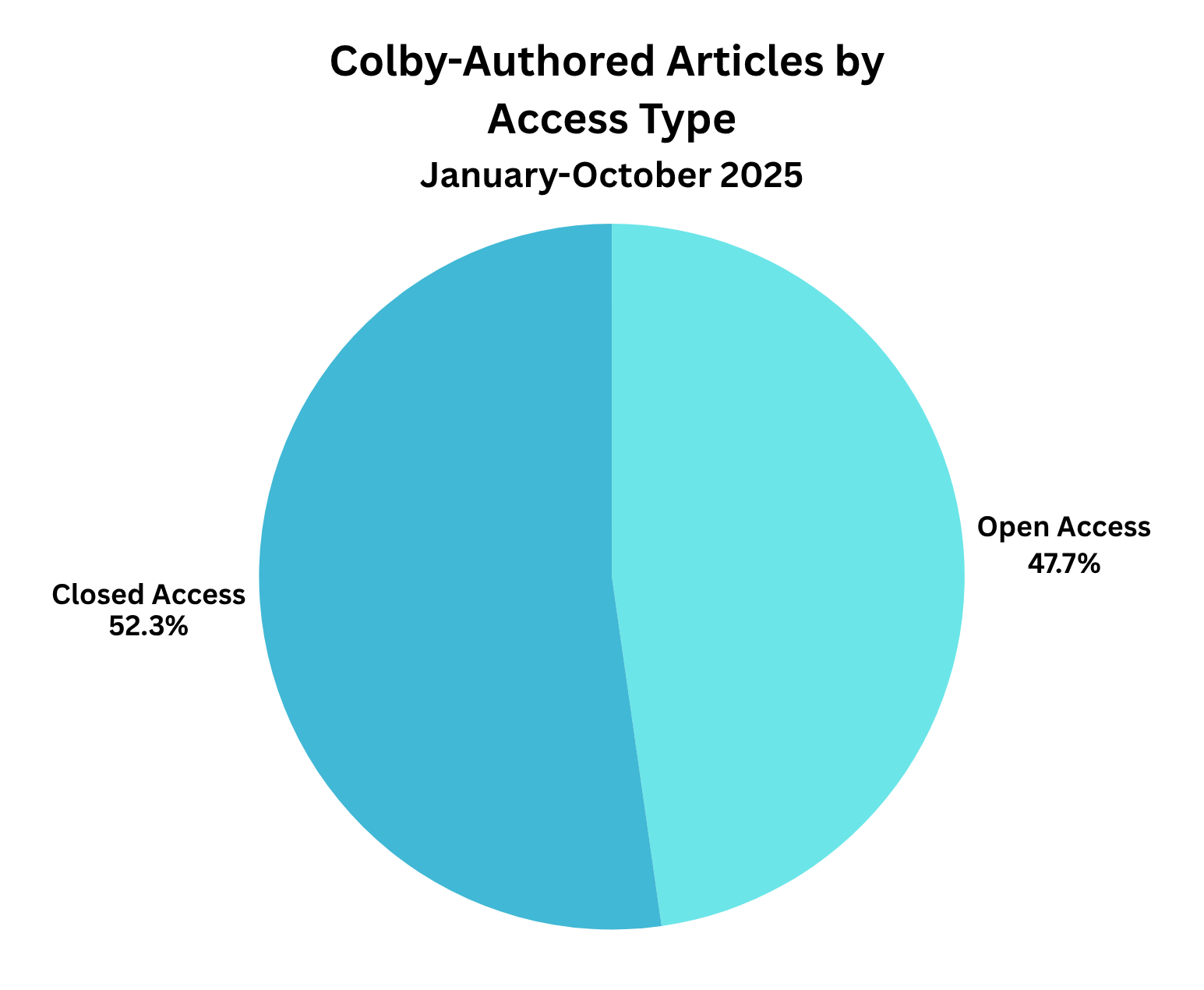
Of the 111 overall articles published by Colby faculty and staff researchers this year, there is an almost even split between closed access and open access titles. This means just under half of Colby authors were able to retain ownership of their copyright when publishing their articles.
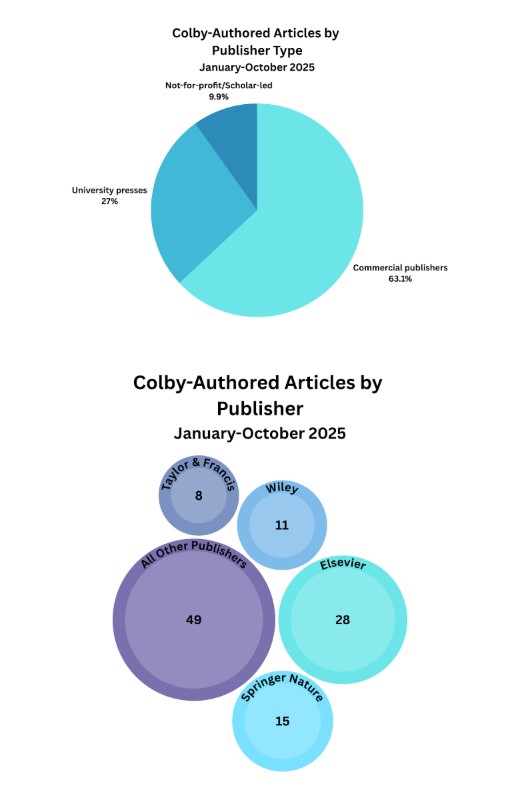
Most Colby-authored articles appear in scholarly journals published by traditional commercial publishers, with Elsevier, Springer Nature, Wiley, and Taylor & Francis representing the majority of those publishers. Under 40% of Colby’s articles are published by university, non-profit, or scholar-led presses.
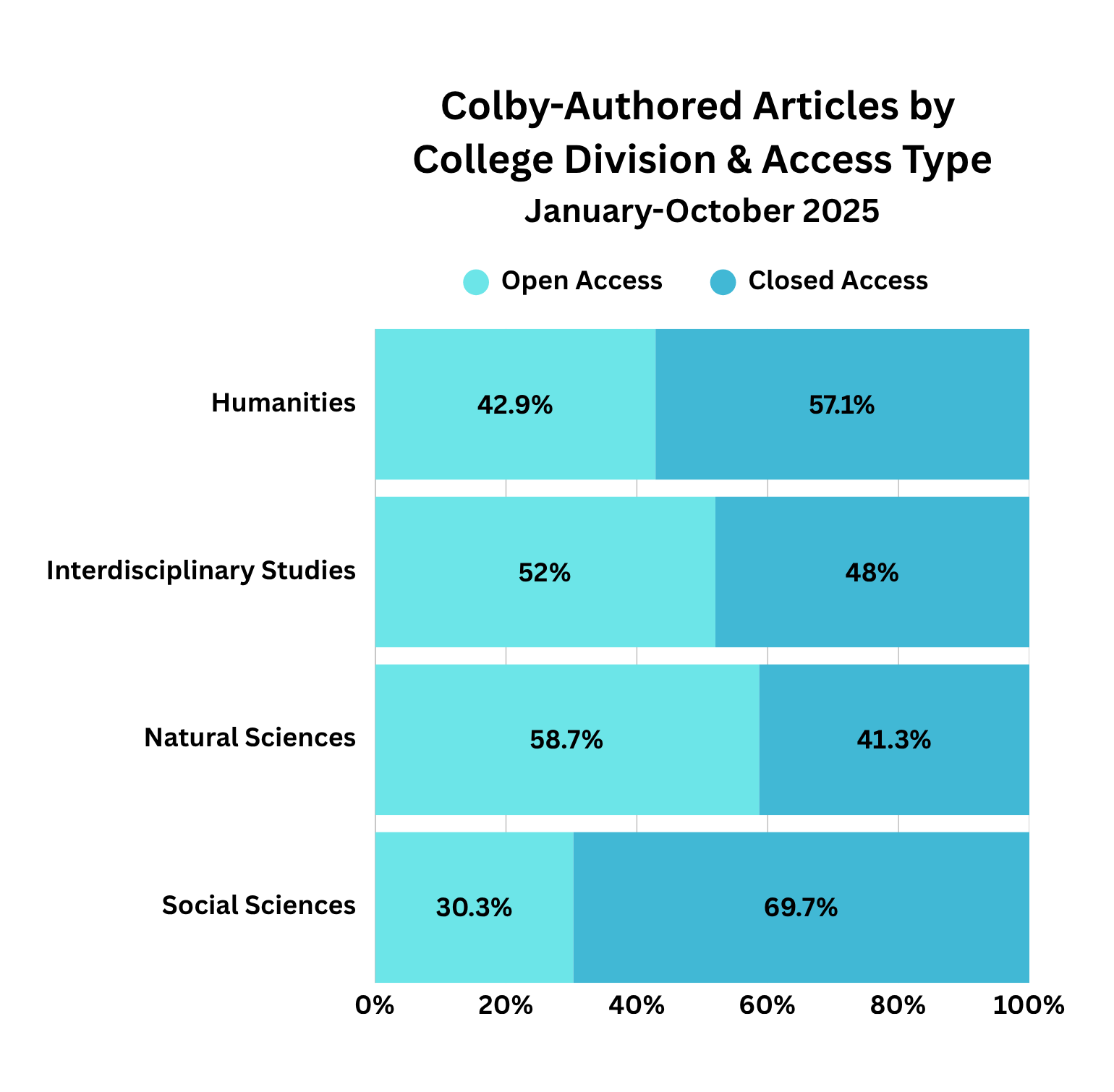
If we break down articles published by the four academic divisions of the College, we can take a more granular look at publication behavior differences by disciplines. While open access article publishing at Colby this year appears relatively common among the Humanities, Interdisciplinary Studies, and Natural Sciences divisions, this does not appear to be the case for the Social Sciences division, which has only published open access 30% of the time.
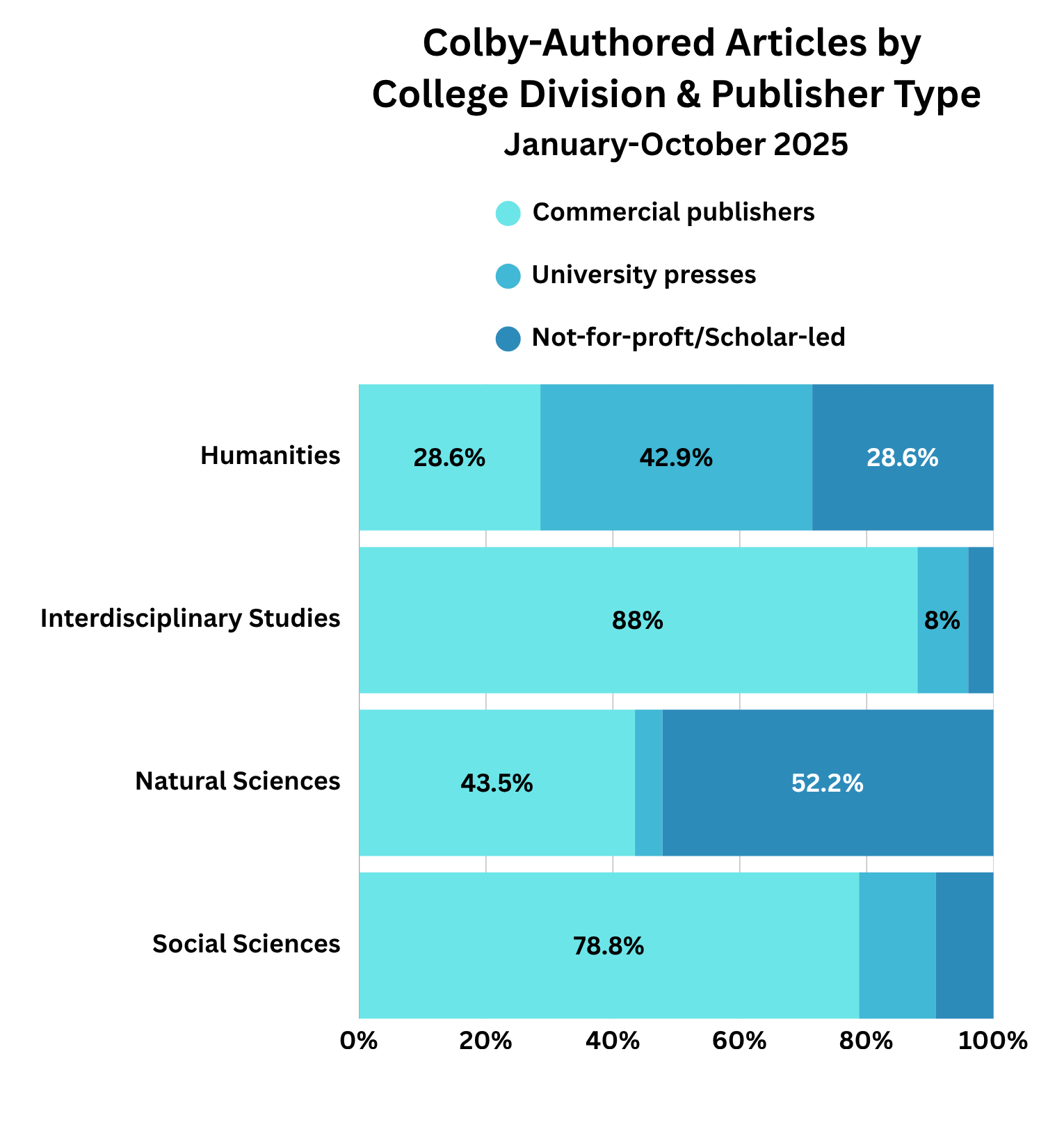
We can also observe variations in the types of publishers preferred by different disciplines. While researchers in the Social Sciences and Interdisciplinary Studies divisions publish their articles overwhelmingly with traditional commercial presses, researchers in the Natural Sciences division are represented almost evenly by commercial publishers and not-for-profit/scholar-led presses. Researchers in the Humanities division publish their articles primarily in university presses, with the remainder evenly distributed between commercial and not-for-profit/scholar-led presses.
When we ask ourselves in 2025 who owns Colby’s knowledge (as represented by scholarly research articles), our answer varies. While nearly half of Colby’s researchers have retained ownership of their copyright through open access publication, over half of Colby’s researchers are not guaranteed to have retained the copyright in their published work. This retention would depend on the details of their individual publication agreement with the publisher.
With the majority of our articles published by just 4 commercial presses, we can see how knowledge can be consolidated by for-profit publishers. Closed access articles in commercially-published journals often require prospective readers to attain access through either an individual article purchase or via institutional subscription. Individual purchases can be cost-prohibitive for unaffiliated researchers, and institutional subscriptions to commercial publisher databases make up an ever-increasing and unsustainable portion of academic library budgets.
When Colby authors are able to publish openly, we not only are able to retain ownership over our own knowledge production, but we also greatly expand the availability of our research insights to the larger public. If you are interested in publishing open access or have questions about this post, please contact Natalie Hill, Scholarly Communications Librarian.